Archive for Technology

The Hug Shirt

The Hug Shirt is a Bluetooth accessory for Java enabled mobile phones. Hug shirts don’t have any assigned phone number, all the data goes from the sensors Bluetooth to your mobile phone and your mobile phone delivers the hug data to your friend’s phone and it is seamlessly transmitted Bluetooth to his or her shirt!
Sending hugs is as easy as sending an SMS and you will be able to send hugs while you are on the move, in the same way and to the same places you are able to make phone calls (Rome to Tokyo, New York to Paris).

The system is very simple: a Hug Shirt (Bluetooth with sensors and actuators), a Bluetooth java enabled mobile phone with the Hug Me java software running (it understands what the sensors are communicating), and on the other side another phone and another shirt. If you do not have a Hug Shirt but know that your friend has one you can still send them a hug creating it with the HugMe software and it will be delivered to your friend’s Hug Shirt!

The Hug Shirt

The Hug Shirt is not meant to replace human contact, but to make you happy if you are away for business or other reasons and you miss your friends and loved ones! It also has some very interesting applications in the medical field with the elderly and children. And is fun to use and very soft!

Seen on CuteCircuit | via Lichtgeraakt

Bill Gates Keynote In Brussels

Robin, my marketing-blogger/colleague over at marketingblog.eu sent me a file about the first video-project they did for Datanews. They (VNU) taped the keynote Bill Gates gave yesterday in Brussels at the Microsoft Business Innovation Event and in it he runs through a brief history of the most important IT developments of the past 10 years and he shares his vision on how software can be used as an instrument to simplofy business solutions. I’d normally have posted this on Inside Microsoft, but since Vizaweb’s still down, I’ll post it here.

Or see it at Soapbox

Search Update: Virtual Earth & Like

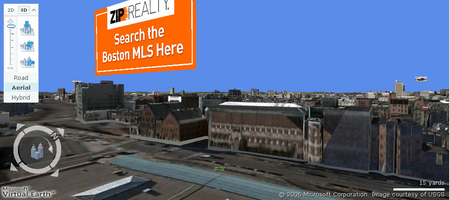
There’s quite a lot of stuff going on in searchland these days, and since I’m kind of really interested in that, I’ll do a write-up on the major things that have occured. First of all there’s Virtual Earth 3D, the upgrade of Live Maps - part of Live Search. What’s special about this release is that, as I’ve predicted in May when Microsoft’s acquired Massive, there’s now advertising in the virtual world, somewhat like the sort you have in Second Life, but this time for actual companies in real life. The maps aren’t a sim, they’re real and for now there’s already 15 cities that have been virtually digitized. In these cities you can see clickable billboards which open a new browser window and load the site of the advertiser. I’m not quite sure if there are rules to follow, but I imagine you can’t have a clickable billboard for 7/11 above a Wall-Mart location. Common sense will be regulated I think. It sounds logical that business owners should be able to advertise in the near surroundings of their business, most likely floating above the business location. What I do wonder about is the fact that you cruise the cities (streetlevel view) and most likely will see the existing billboards that have been photographed as well. It would be cool if Microsoft could cash out on that and have their own ads featuring on those locations, or block out that free and uncontroled advertising to master the essential part, namely those ads they approve of. Here’s an example image of a floating billboard for Zip Realty in Boston. (courtesy of AdverLab)
Next:

Like.com Visual Search. What exactly is it? Like allows users to find products by appearance. That means as much as: if you see a picture with an object in it you fancy, the like engine is able to render ’similar’ things for you. Check out how that works with, for instance, Brad Pitt. Like scores some celeb pics, defines the ‘hot zones’ that feature accessories and then turns those items into shopable content. There seems to be a co-operation with Getty images, because practically all celeb images have a (c) Getty under them. What’s pretty neat is that when you’ve clicked on a celeb pick to start a search, a lot of items are being retrieved which can then be customized by the user. With a color picker you can set the right color, with a slidebar you can set a price range and eventually you can select a brand, a specific site and a few more options to narrow down your search. Pretty clever stuff for online shoppers. It seems that, for now, the search is limited to jewelry, shoes, handbags and watches, but normally that should be extended as soon as Riya upgrades Like to Beta instead of Alpha. If you’re a manufacturer of products, you can add those through the form, so they’ll be included in the search results. Stay tuned for this one.
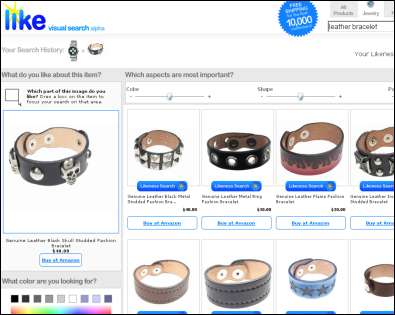
Like.com

Check out Like | via Google Blogoscoped
Touch Me Tender Interface

A little while ago I received an e-mail from Stan Kravetz, the COO of KsanLab. Over at KsanLab, they’ve been developing a tactile interface that looks really slick. The ‘Touch Me Tender’ interface is a product which is designed in order to use “natural” human interaction to avoid intermediates such as menus, mouse and so on. It makes interaction more convenient and eliminates the need for any special IT education. So it opens a door for new customer experience for a broader range of users. Interesting perspective. Not ground-breaking (I’ve seen such concepts before), but I’ve never seen the ‘paint’ application as extended as it is pictured in the clip below.

Over at KsanLab, they see following applications of Touch Me Tender at the moment:

  1. Development of interactive P.O.S. terminals those can be integrated with web projects, services and campaigns.
  2. Entertainment at shopping malls, restaurants, airports, museums, etc.
  3. An experiential marketing tool: a customer interacts with the product in a tactile way (selection and virtual test of make-up, clothes, furniture).

What I’m fond of is that instead of focusing on the ‘gaming market’, they’ve shifted the focus to the ‘marketing market’, and by doing so they’ve drilled a far bigger audience. [Plus it got them on this blog :)]

More info? check out www.KsanLab.com

Other slick interfaces on Marketing Thoughts:

Graph Your Site

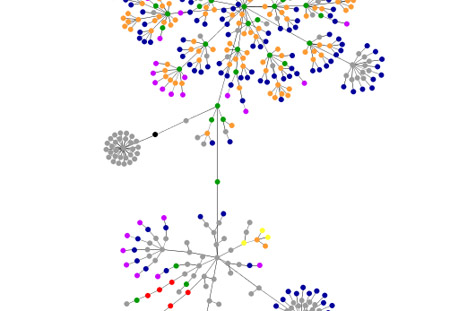
I’m probably nearly the last one in the world to see this, but since I’m adding the image to the Flickr group, I thought I might as well blog it too so it’s ‘out there’. Sala programmed an HTML Graph Applet that renders your site into a graphical structure. Sala is an artist who’s active on many platforms. His alter ego art-project, onethousandpaintings.com, has also travelled the globe very fast. From the 1000 paintings he had on sale, as many as 583 are already sold. Amazing.

Marketing Thoughts Graph

See my graph being made | Create yours
On Flickr, 2023 photos have already been tagged with the websitesasgraphs keyword. Feel free to add yours.

Emerce eDay Swag

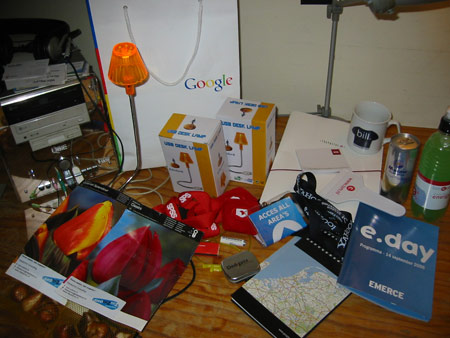
Here’s a picture of the loot of today :) After all, what would a marketing event be without swag? In the Flickr set from the Emerce eDay, I’ve also added two dozen of other pictures from the morning train ride, and from the event itself at the Van Nelle factory in Rotterdam. Surprize of the day was without any doubt when I met Hans Mestrum at the end of the event. Too bad we didn’t saw each other earlier. Maybe next time there’ll be time for a beer and a chat. I hope so.

Swag from eDay

Tulips, a coffee mug, decorative USB lights, mints from Commence and Dedigate, a Google bag, some key rings, some key rings with ribbons, a dozen of pens, Google notebooks with “I’m feeling lucky” on the bottom of each blank page, energy drinks and post-it notes, an ice scraper for the windows of the car, my oxygen feeder from the oxygen bar and a pair of sweatbands for the wrists.
Nice treasure. Cool day.

/ eDay site /

All five posts in a row:

° Live From eDay: Google Earth Keynote
° Live From eDay: Second Life
° Live From eDay: Two Sessions
° Live From eDay: Jaffe Juice
° Live From eDay: Ben Hammersley

All posts have been cross-posted on i-wisdom.

Live From eDay: Ben Hammersley

Ben Hammersley, a globe-trotting lunatic in a kilt and wearing army boots, has some deeper insights in the way life is going. He’s been around the world and apparently he’s quite the rebel. Tune in for some thoughts:

We’re undergoing a new Renaissace. The original Renaissance was a time of great change, a time of new technologies and great breakthroughs in art, sciences and medicin. Let’s talk about human development. Art, for example: ‘caveman goes shopping’ - a suggestive drawing of a wall painting from the Stone Age, picturing a caveman who pushes a shopping cart. Human development is a thing that is going up and down in cycles. From cave-painting to Michael Angelo’s “The David”. There’s a rate of change. A rise and a fall. Things start up pretty low down, blossom up and then go back down again. After the Romans, we had the Dark Age; After the Dark Age, we had the Renaissace…. and so on until today.

Something weird is happening today and has been happening over the past ten or fifteen years. The human society is undergoing a change that has never happened before in the history of human beings. Technology has always been a bit self-limiting, up until today. Computers aren’t like horses. At first horses were wild and unpredictable until some started domesticating them and then saddle them so they became means of transport. Computers are unique. You use today’s computers to produce tomorrow’s computers. You never get to the point like with the horse where you reach the maximum of its capacity, and unless you started breeding them with five legs, that’s the end of that.

We’ve got a technology that can’t slow down, it’ll only get better, it builds upon itself. IT changes everything else in our lives. It’s a chain reaction.

“Information Technology builds upon itself and facilitates every other type of progress.”

A new form of collaboration: a new set of challenges for everyone. It’s like being Gallileo’s best friend. Our grand kids are going to sit on our knees and we’ll get to tell what the internet was like when it first started.

The point: we’re lucky bastards, we’re at the beginning of a new revolution. We get to see it evolve. This is the only revolution that isn’t going to slow down and stop. It’s completely changing our lives as we know it.

But, we’re also unlucky bastards, our grandchildren are going to ask us: what did you do at the beginning of the revolution mommy? And you, grandfather, where were you at the very start of the internet? That brings us to the message of today:

We’re reconfiguring human existence. We start tomorrow, after the drinks.

So, that concludes a very interesting day. It was very well organized, the food was good and talks were of a very decent level. I learned a lot and got some more insight in different forms of marketing. I saw a lot of new interesting things and I’ve gotten a lot of new ideas. And that was the entire purpose of the day.

/ eDay site /

Live From eDay: Jaffe Juice

Existing traditional media is in troubles. The 30 second spot is taking its last breath. Broadband & wireless networks initiate an endless offer. Digital video recorders made it possible to simply skip the commercials. The consumer become more intelligent, more sceptical and more critical. Merciless, he looks through the offers, if he can still remember the commercial due to the overload. So we need new ideas to connect brands and consumers.

Introducing new marketing:

Jaffe: It’s irrelevant whether or not the 30 second spot is dead. The book says: there’s life after the 30 second spot, which means: there’s more out there. Traditional advertising is represented by three colors: print, tv and radio. Right now, instead of three colors, there are 93 colors out there, as a metaphor. We as consumers owe it to ourselves to understand, explore and integrate them. We need to explore these colors, these channels, to figure out how and when we want to use them, explore them.

Nothing is linear anymore, nothing is one way. Everything is part of something bigger. Everything is part of ‘conversation’. Everything has another meaning than the obvious one you see or experience.

In the olden days:

  • Companies lied
  • Companies pretended they were deaf
  • Companies surrounded themselves with “Yes-Men”
  • Companies coasted on being “part of the chasing pack”
  • They focused on the “median consumer”

They never focused on the influentials, the innovatives. The mediocre consumer who never fought back, who never participated was (and in most ways still is) the target audience of many brands.

You think the olden days would be in the past, but no, the olden days are for many companies: today.

Pepsi: win a 99 cent download on i-tunes, 1 in 3 wins. Error in this form of thinking: if 1 in 3 wins, that means 2 in 3 are losing.
One consumer figured out that if you tilt the bottle 25 degrees, you can see the code. He puts it online on his blog and all of the sudden 1 in 1 can win. That’s consumer power. Marketers have become powerless. They run behind consumers that outsmart them, tryinh to hit them with a blunt object until they are numb. But it backfires.

Reach ° Connect ° Effect

The key is ‘wireless’.

In the early days, if you pissed off a consumer once, he’d tell 15 to 20 friends. If you made him happy, he’d tell 7 friends. Nowadays if you piss off a consumer once he’ll say: “screw you, I won’t tell 15 to 20 of my friends, I’ll tell 100 million of my closest strangers.” The ‘New’ consumer is connected anywhere and anytime on their terms.

Average consumers spent 7,5 minutes with the subservient chicken. That equals 15 commercials. The media defines itself. We read papers, we listen to the radio and we watch television… but we interact on the internet. Internet is the integrator. The web makes into a whole by connecting all the different parts. It unifies and unites the big idea by offering a way to distribute it immediately.

We can’t look at the web as a medium. It’s whatever the consumer and marketer wants it to be. Calling it a medium is limiting the possibilities of it.

The web is not sold out, it creates unpolluted new iventory every day. CGC causes the web to get bigger and better every day. Media sellers should no longer hold you hostage. There’s new and other ways to get in touch with consumers, to channel your message.

Of the IM generation i.e. those born after 1980, 62% of the content they consume comes from people they know personally.

The many to many model: all the conversations that go on a once. As brand you can be invited to join the conversations, to participate to catalyse and maybe even make it better. You can use multiple channels at once and interact with an exponentially growing number of consumers.

Refers to ‘Red Paperclip Guy’ aka Kyle Macdonald. From ‘A’ via C,D,E,F,G,H,I,J,K,L,M,N and O to B (from the paperclip to the house via a lot of different people). It wouldn’t have worked if Kyle would have been sponsored by some brand who bought him the house. The story wouldn’t have been the same. It worked because it simply was ’sincere’ and ‘honest’. It was 100% consumer generated.

Ultimately new marketing is a state of mind, it’s a culture shift. Don’t take the 30 second spot and put it online like that. Participate in conversations and try to capitalize the outcome.

It’s what I’ve never seen before that I recognize. - Diane Arbus -
It’s what they do recognize, they shut out. - Joseph Jaffe -

End of keynote / Panel discussion starts here.

/ eDay site /